Intune Architecture and Service Model
Atlanta, USA

Last updated: 2026-08-04
Design objective
Define a cloud-first endpoint control plane that aligns identity, device, app, and data posture in one operating model.
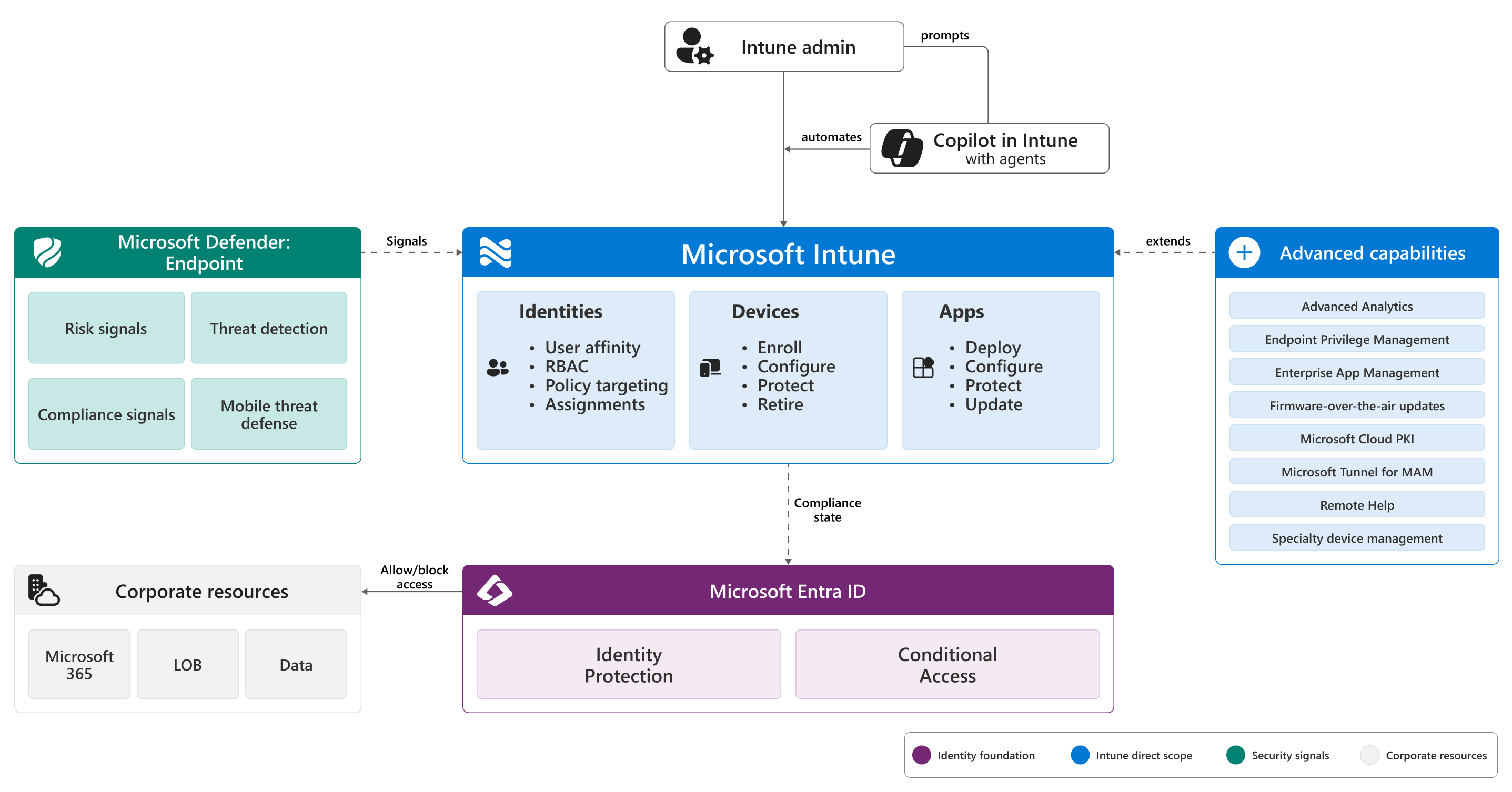
Source: What is Microsoft Intune?.
Core pillars
| Pillar | Purpose |
|---|---|
| Identity | Authenticate users and define access trust context |
| Devices | Enroll and evaluate endpoint posture |
| Apps | Deliver and protect productivity and business apps |
| Access control | Enforce Conditional Access using compliance and risk signals |
| Operations | Monitor health, enforce governance, and continuously improve |
MDM (mobile device management) and MAM (mobile application management) strategy
- MDM (mobile device management): full device control, preferred for corporate-owned endpoints.
- MAM (mobile application management): app and data protection without full device management, preferred for BYOD (bring your own device).
- Combined mode: full device management plus app protection for high-sensitivity workloads.
Control boundaries
- Identity and group model in Microsoft Entra.
- Device ownership and enrollment model per platform.
- App protection and data movement restrictions.
- Compliance state and access enforcement model.
- Support and remediation ownership model.
Architecture anti-patterns
- One global policy ring for every device type.
- Treating BYOD (bring your own device) and corporate-owned as equivalent risk models.
- Applying blocking Conditional Access before compliance and remediation workflows are stable.
- Skipping pilot validation for network, enrollment, and app delivery dependencies.